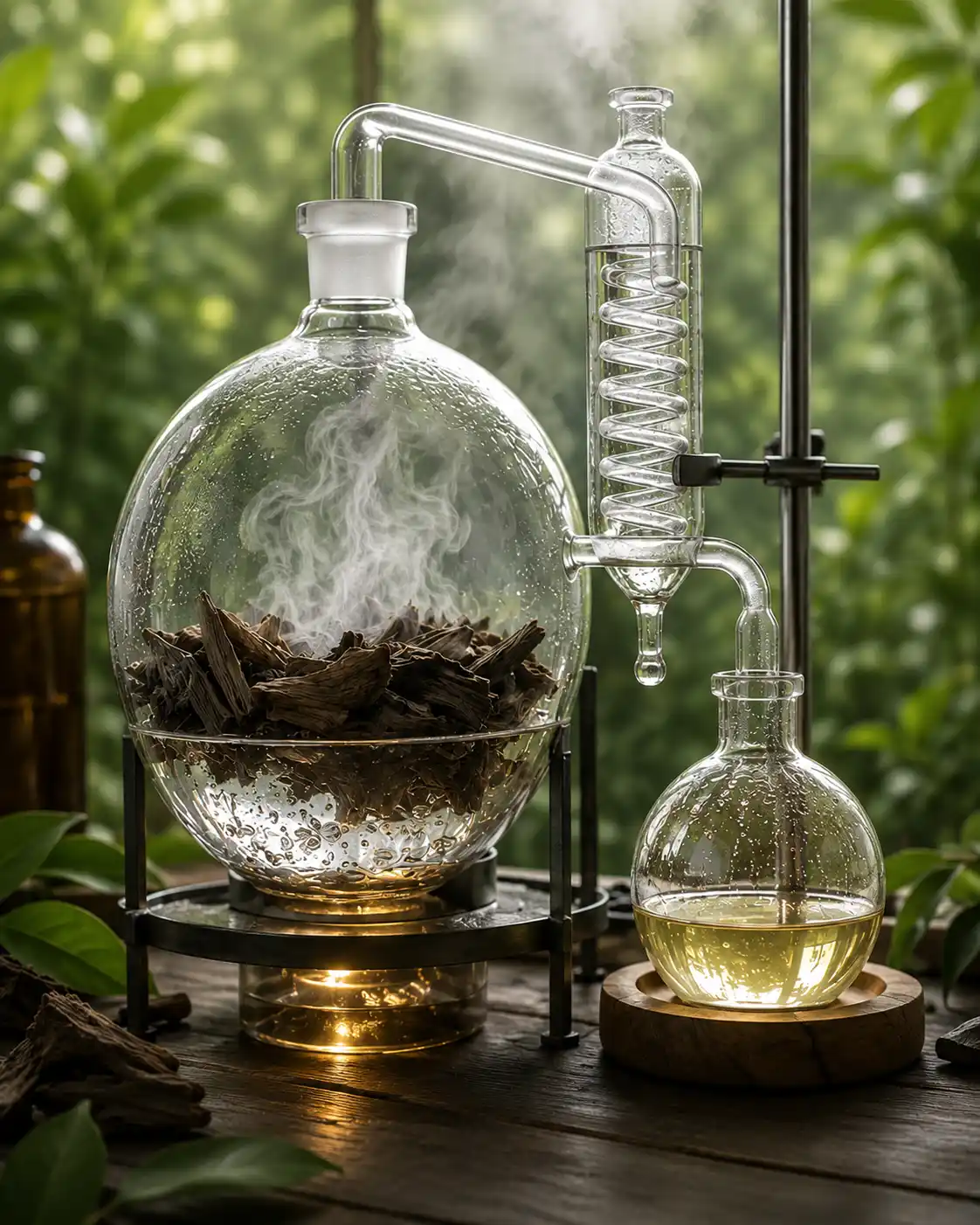
Pure oud oil is produced through the artisanal steam or hydro-distillation of pulverized resinous agarwood. The wood is crushed, optionally soaked in pure water to soften cellulose fibers, and heated in specialized alembics for multiple days. As steam vaporizes the heavy sesquiterpene resin molecules, the vapor travels through cooling coils, condenses into a separator flask, and is skimmed off the hydrosol as pure, viscous oil before undergoing gentle curing and glass maturation.
The distillation of pure oud oil (traditionally celebrated as Dehn al Oud) represents an extraordinary intersection of botanical chemistry, thermodynamics, and sensory alchemy. While modern industrial extraction often prioritizes rapid solvent throughput, genuine artisanal oud oil is born from slow, unhurried distillation that respects the delicate molecular integrity of the raw wood.
Here we demystify the complete distillation process, distinguishing general industry practices from the sustainable environmental principles that guide modern craft producers.
Step 1: Wood Selection and Mechanical Preparation
Quality distillation begins with raw material selection. While top-grade sculptural sinking pieces are conserved for private collections, high-resin shavings, chips, and root nodes are designated for the distillery.
- Chipping and Shaving: Solid agarwood pieces are reduced to uniform thin splinters or coarse flakes using specialized mechanical chippers or hand planers.
- Milling / Grinding: The chips are pulverized into coarse wood meal. Creating the correct granule size is critical: if too fine, the meal forms an impermeable sludge that blocks steam flow; if too coarse, hot steam cannot penetrate the interior resin channels.
Step 2: Maceration and the "Soaking" Debate
One of the most consequential decisions in oud production involves maceration—soaking the ground wood in water prior to firing the still:
| Method | Duration | Impact on Olfactory Profile |
|---|---|---|
| Traditional Long Soak | 14 to 30+ days | Microbial fermentation softens wood cells, increasing yield and generating deep, rustic, leather, and animalic facets (prized in traditional Gulf perfumery). |
| Short / Controlled Soak | 3 to 7 days | Hydrates cellular fibers without significant fermentation, producing balanced woody-balsamic warmth. |
| Zero Soak / Fresh Distill | 0 to 24 hours | Yield is lower, but the resulting oil displays pristine clarity, bright fruit/floral opening notes, and zero barnyard funk. |
At Nature's Treasure, our focus is centered on clean, 100% environmental distillation that highlights the natural elegance of the botanical wood, avoiding excessive decomposition in favor of refined, honeyed, and balsamic woody complexity.
Step 3: Distillation Mechanics — Hydro vs. Steam
In the artisanal world, two primary distillation architectures predominate:
1. Traditional Hydro-Distillation (Deg & Bhapka)
In hydro-distillation, the wood meal is placed directly into a pot still filled with pure spring water. A fire or regulated gas burner heats the kettle to a gentle boil. As the water boils, water vapor physically carries the suspended resin droplets upward through a gooseneck pipe into a water-cooled condensing receiver. This technique is known for capturing heavy, grounding base notes.
2. Environmental Steam Distillation
In modern environmental steam distillation, steam is generated in an external boiler and routed through the bottom of a sealed stainless steel or copper column holding the wood meal on perforated trays. The dry, controlled steam extracts the aromatic fractions at carefully regulated temperatures without submerging the wood in boiling water. This method prevents burning and ensures unparalleled purity.
Step 4: Condensation and Collection
As the aromatic vapor exits the alembic head, it enters an elongated condensing coil surrounded by circulating cold water. The sudden temperature drop forces vapor to condense into a liquid mixture known as hydrosol.
Because pure agarwood essential oil has a specific gravity slightly lower than water (typically 0.95 to 0.99 g/cm³), the tiny amber droplets of oil gradually rise and float on the surface of the receiver flask (Florentine flask). The distillation runs continuously for 72 to 120 hours, with drops accumulating fraction by fraction.
Extraction yields are humbling. Extracting just 3 milliliters (one-quarter of a tola) of pure oud oil frequently consumes 3 to 8 kilograms of prime resinous wood. To produce a single kilogram of pure essential oil requires hundreds of kilograms of selected Aquilaria heartwood.
Step 5: Hand Skimming, Sun-Curing, and Glass Maturation
Once distillation concludes, the master distiller carefully skims the thin golden-amber oil layer from the water using precision glass pipettes.
However, the freshly collected oil is not yet ready for the bottle:
- Dehydration / Sun Curing: Fresh oil contains minute water droplets suspended in emulsion. The oil is placed in shallow glass bowls covered with fine muslin cloth and gently warmed under filtered morning sunlight or mild heating pads. Evaporating every trace of water prevents bacterial degradation and clarifies the oil to gem-like transparency.
- Filtering: The oil passes through fine lab-grade filters to remove microscopic wood particulates.
- Maturation in Glass: The pure oil is transferred into airtight borosilicate glass carboys and rested in darkness for 6 to 24 months. During this resting phase, harsh "still notes" dissipate, and complex sesquiterpene esters polymerize into a seamless, deeply harmonious aromatic masterpiece.
Cambodian Vintage Oud Reserve
Distilled from dense resin heartwood and aged in glass carboys for exceptional depth, leather notes, and longevity.
Frequently Asked Questions About Oud Distillation
In hydro-distillation, pulverized agarwood is completely submerged in boiling water inside the pot still, yielding deep, rich, and traditional earthy profiles. In steam distillation, pressurized steam passes through a suspended bed of wood chips, extracting volatile aromatics at precise temperatures to produce brighter, cleaner, and more floral-woody nuances.
Maceration (soaking) softens dense timber cells and initiates subtle natural fermentation that breaks down complex plant walls, increasing extraction yield and imparting characteristic leathery, barnyard, or deep animalic facets cherished in traditional Gulf markets. Shorter or non-fermented soakings yield cleaner, sweeter profiles.
Because extraction yields typically range from 0.1% to 0.3% depending on resin density, it generally takes between 3 to 8 kilograms of selected resinous wood chips to extract a single 3ml flagon (quarter tola) of pure artisanal oud oil.
Freshly condensed oud oil carries microscopic droplets of hydrosol (water) and volatile "still notes" (sulfuric or metallic sharpness). Sun-curing evaporates moisture, while resting in glass carboys allows heavy sesquiterpene compounds to stabilize into a rounded, harmonious olfactory bouquet.