Oud (from the Arabic al-‘ūd, meaning "wood") refers specifically to the resinous wood of the Aquilaria tree and, most prominently, to the precious essential oil extracted from it via artisanal distillation. Celebrated for its intense balsamic, woody, and leathery complexity, pure oud oil serves as one of the most revered foundation notes in global perfumery and Arabian ceremonial tradition.
In contemporary luxury perfumery, few words carry the magnetic allure of "oud." Over the past two decades, nearly every international fragrance house has introduced an oud-centered creation. Yet behind this commercial popularity lies a rich, ancient botanical heritage that is often obscured by marketing jargon.
To truly appreciate oud, one must understand how a living tree transforms trauma into an aromatic treasure, and how traditional distillation captures that soul in liquid form.
The Relationship: Agarwood vs. Oud Oil
At the most fundamental level, agarwood and oud are physical expressions of the same botanical substance:
- Agarwood: The physical, solid resinous heartwood harvested from Aquilaria trees. It can be appreciated in raw sculptural pieces, carved beads, or chopped into thin splinters to be burned over charcoal as incense.
- Oud Oil (Dehn al Oud): The viscous, concentrated essential oil extracted by crushing the resinous wood and subjecting it to prolonged steam or hydro-distillation. It is traditionally worn directly on the skin as an undiluted pure perfume oil.
In Arabic, Dehn al Oud translates literally to "the fat of the wood," an evocative description reflecting the rich, unctuous density of the pure extracted oil. To read about the complete botanical background of the raw wood, explore our overview of what agarwood is.
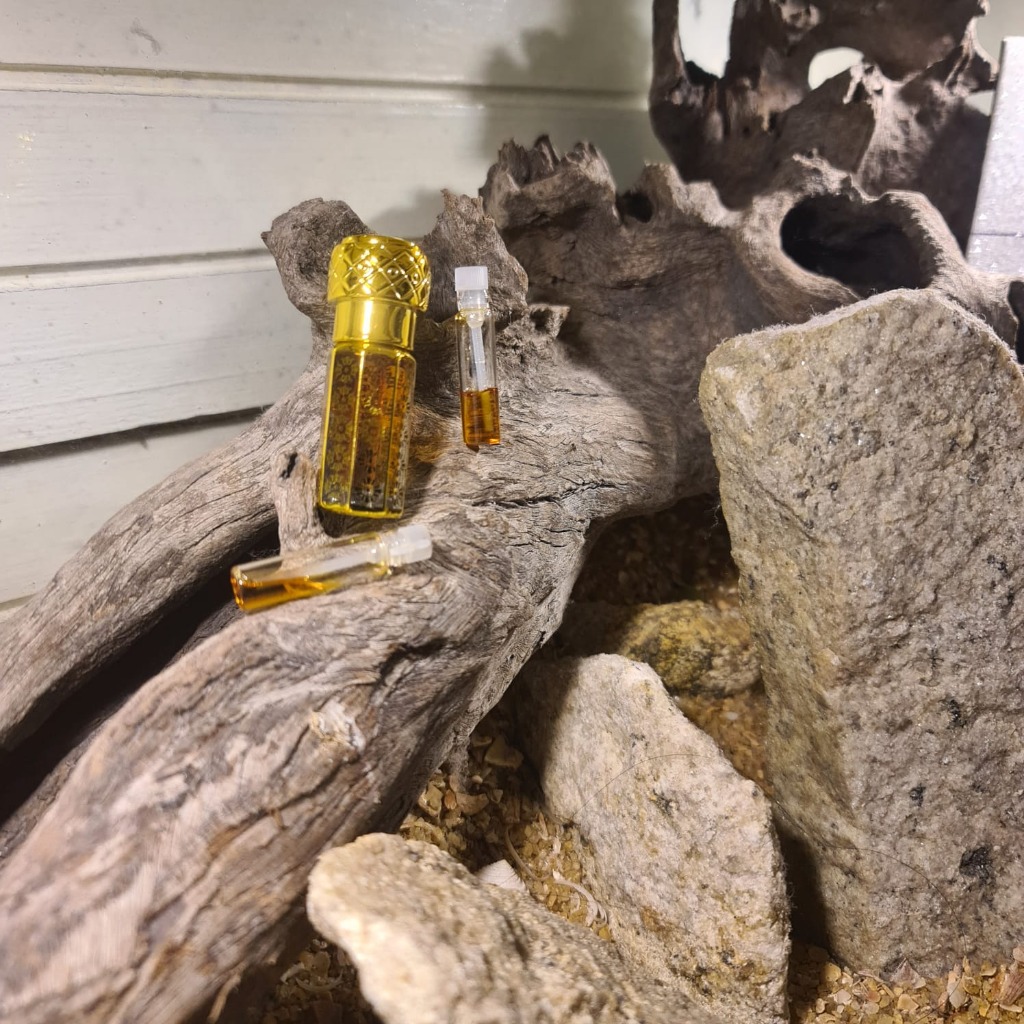
How Oud Fragrance Develops on the Skin
One of the most defining characteristics of authentic pure oud oil is its dramatic olfactory evolution. Unlike synthetic commercial fragrances—which are engineered to deliver an immediate, static blast of scent—pure oud is a living aromatic matrix containing hundreds of volatile, semi-volatile, and heavy sesquiterpene compounds.
When applied to pulse points, oud transitions through distinct olfactory stages:
| Phase | Timeframe | Dominant Olfactory Notes |
|---|---|---|
| Opening (Top Notes) | First 10 to 30 minutes | Can be bold, rustic, or slightly medicinal; bright wood shavings, damp moss, leather, or subtle fermented warmth. |
| Heart (Mid Notes) | 1 to 4 hours after application | Softens dramatically; reveals smooth cedar, deep balsamic resin, warm honey, dried fruit, and antique library wood. |
| Drydown (Base Notes) | 5 to 24+ hours | Profound, serene, and intimate; creamy sandalwood-like sweetness, clean amber, dry earth, and warm golden musk. |
First-time explorers of pure oud are often startled by the intensity of the opening minutes. However, seasoned collectors evaluate an oil primarily by its heart and drydown—the serene, hypnotic trail that lingers long into the following day.
The Distillation Concept: From Wood Chips to Liquid Gold
Distilling oud is an exacting craft that balances physical science with sensory intuition. While modern industrial essential oils (such as eucalyptus or citrus) are extracted rapidly at high pressure, extracting the heavy, high-boiling-point resin molecules of agarwood requires patience:
- Chipping and Powdering: Resinous heartwood is finely pulverized to increase surface area contact with water.
- Maceration (Soaking): In traditional methods, the wood meal is soaked in pure water for days or weeks, allowing natural enzymatic fermentation to soften wood fibers and unlock deeper, barnyard or leathery facets. Modern "clean" distillations often skip prolonged soaking to preserve bright, airy floral-woody top notes.
- Distillation: The wood is heated in copper or stainless steel alembics for 3 to 7 consecutive days, allowing steam to carry vaporized resin molecules into a condensing cooling coil.
- Separation and Curing: The oil floats to the top of the condensed hydrosol, where it is skimmed by hand, filtered, and sun-cured or aged in glass carboys to remove trace moisture.
For a step-by-step breakdown of alembics, temperature controls, and condensation, read our comprehensive guide on how oud oil is made.
Essential Buyer Terminology: Dehn al Oud, Attar, and Mukhallat
When navigating the world of traditional and luxury fragrance, buyers frequently encounter several key terms that describe different product formats:
- Pure Dehn al Oud: 100% undiluted essential oil distilled exclusively from agarwood. Contains zero carrier oils, alcohol, or synthetic additives. Sold in fractions of a tola (typically 3ml or 6ml).
- Attar (Ittar): Traditionally, an essential oil distilled directly into a base of pure sandalwood oil via hydro-distillation, capturing a seamless fusion of botanical aromatics.
- Mukhallat: An artisanal perfume blend (from the Arabic for "mixed") featuring pure oud as a central base note combined with complementary natural oils such as Taif rose, amber, saffron, and musk.
- Eau de Parfum (EDP) with Oud: An alcohol-based spray fragrance formulated with a percentage of perfume concentrate. In mainstream perfumery, this concentrate is usually composed of synthetic woody-amber aroma chemicals rather than pure distilled oud oil.
Due to high value, the market contains numerous synthetic imitations and adulterated oils cut with odorless carrier oils (such as dipropylene glycol or white mineral oil). To learn how to evaluate purity and protect yourself as a buyer, consult our guide on how to identify genuine agarwood and oud.
Royal Ceylon Pure Oud Oil
Distilled from 8-year mature Aquilaria trees grown with zero chemical additives. Warm woody profile with golden honey undertones.
Frequently Asked Questions About Oud Fragrance
Pure oud oil possesses a remarkably rich, multi-dimensional fragrance that cannot be described with a single note. It typically features deep woody, warm balsamic, leathery, and earthy notes, frequently accompanied by sweet dried-fruit, tobacco, honey, or soft smokiness depending on the tree's botanical origin and distillation technique.
Most commercial spray perfumes labeled "Oud" contain an alcohol base with synthetic aroma accords (such as synthetic woody-amber molecules) and either trace amounts or no actual agarwood oil. In contrast, pure artisanal oud oil (traditionally called Dehn al Oud) is a 100% undiluted essential oil distilled directly from resinous agarwood, applied in minute drops using a glass wand.
The tola is an ancient Vedic and Middle Eastern unit of mass equal to approximately 11.66 grams (roughly 12 milliliters of oil). Due to the high value and concentration of pure oud oil, it is traditionally sold in fractions of a tola—most commonly a quarter tola (3ml) or half tola (6ml).
Unlike alcohol-diluted perfumes or citrus essential oils that oxidize quickly, pure oud oil contains heavy sesquiterpene compounds that actually improve with age when stored in dark, airtight glass containers away from extreme heat, developing greater depth, roundness, and smoothness over decades.